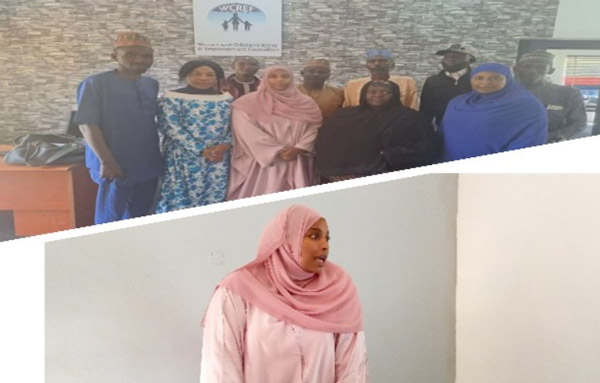
…Wants Gov’t to work with CSOs to implement existing policies, laws By: Mayen Etim KADUNA, North-West Nigeria – The NGO, Women and Children’s Rights and Empowerment Foundation, (WCREF), has tasked media practitioners to practice gender sensitive Journalism and develop value based media that change the world and challenge gender inequality. Even as WCREF said the fight against Gender-Based Violence, (GBV) is a collective one, the Foundation called on government to work hand-in-hand with Civil Society Organizations, (CSOs) to implement existing policies and laws to curb the menace. Executive Director of WCREF, Barrister Mariam Marwa-Abdu, asserted this at a one-day training for media practitioners on Gender Based Violence (GBV), Sexual Exploitation and Abuse (SEA) and Gender Mainstreaming held in Kaduna on Wednesday, December 6. According to Barr Marwa-Abdu, gender-sensitive reporting is a practice of producing media content in a way that is sensitive to gender inequalities and portrays women and men fairly, it is a key principle of professional media production that is similar to values of accuracy and balance. Earlier in her remarks, the ED said the training was basically on gender mainstreaming -integrating a gender perspective to the content of reporting. She added that participants would be trained on the various forms and concepts of GBV and SEA so that they could get a deeper understanding about the menace. Speaking on ways to fight GBV, Barr Marwa-Abdu said people should first educate themselves on the root causes of the menace, then interrupt sexist or discriminatory language, stop sexual harassment, and stop victim blaming.
Others she said are, “stop rape culture, create safe spaces to discuss gender based violence, stop stereotyping men and women’s roles, understand and practice consent; and through Gender sensitive/mainstreaming reporting.” The ED noted that fundamentally, SEA is a term used to describe inappropriate sexual conduct perpetrated by aid workers against recipients of assistance and other members of vulnerable communities in places like the IDP camps. She said in Nigeria there is the UN Strategy for Protection from Sexual Exploitation, Abused and Harassment, (PSEAH); according to her, this works on strategies and policies to prevent and combat all forms of sexual exploitation and abuse in humanitarian operations. She cautioned media practitioners to refrain from discriminating against or stereotyping clients on the basis of sex or gender. “Treat all clients with equal respect, offering gender sensitivity training to all employees; provide adequate representation of female care providers,” she added. She therefore urged media practitioners to sensitize the people about policies, legal documents and acts such as the Violence Against Person Prohibition (VAPP) Act, Convention on the Elimination of all forms of Discrimination Against Women, Protocol to the African Charter on Human and People’s Rights, the Penal code and Criminal code to keep the people abreast and aware that there are existing laws to protect and promote the rights of women. According to her, people at the grassroots in particular should know about the existence of these laws and policies, because it is difficult on their own to get legal aid or get people to listen to them. “I want them to understand that they’re not alone, as there are actual remedies that they could avail to get perpetrators sent to jail and as well get social support from organizations such as ours.”